
 Q. No.
A simple pendulum of length L is suspended from the ceiling of a cart which is sliding without friction on an inclined plane of inclination . The time period of the pendulum is
1.
2.
3.
4.


A body is placed on a horizontal platform that is undergoing vertical SHM. If the amplitude of oscillation is \(40\ \text{cm}\), then the least period of oscillation for which an object placed on the platform is not detached from it is:
1. \(1.256\ \text{s}\)
2. \(12.56 \ \text{s}\)
3. \(0.1256 \ \text{s}\)
4. \(125.6 \ \text{s}\)
If a pendulum giving correct time on the ground at a certain place is moved to the top of a tower 320 m high, then the loss in time (in seconds) measured by the pendulum clock in one week is:
1. 15.12
2. 7.72
3. 3.78
4. 30.24


Instantaneous acceleration (in ) of a particle executing S.H.M. is given by . The maximum speed of the particle will occur first time at
1. 1.75 s
2. 1.4 s
3. 1.2 s
4. 0.67 s
A particle moves according to the equation . Distance covered by it in the time interval of t =0 to t =3 s is: (symbols have their usual meanings)
1. A
2. 4A
3. 3A
4. 2A
1. \(\frac{3T}{2}\)
2. \(\frac{3T}{4}\)
3. \(\frac{2T}{3}\)
4. \(\frac{4T}{3}\)


A body of mass m hanging with the help of three springs, each of spring constant k as shown. If the mass is slightly displaced and released, then the system will oscillate with the time period
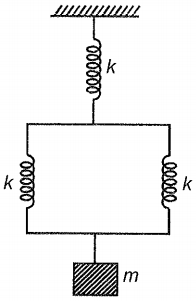
1.
2.
3.
4.
A block of mass m attached to a spring of constant k oscillates on a smooth surface. The other end of the spring is fixed to a wall. When spring is at its natural length, the speed of the block is v. Displacement of the block from its mean position before coming to instantaneous rest is:
1.
2.
3.
4.
A particle under SHM has a maximum speed of 30 cm/s and a maximum acceleration of 60 cm/s? The time period of oscillation (in second) is
1.
2. 2
3.
4. 4


The x-t graph of a particle undergoing SHM is shown below. The acceleration of the particle at is:

1.
2.
3.
4.

© 2026 GoodEd Technologies Pvt. Ltd.