
 Q. No.
The device that can act as a complete electronic circuit is:
1. Junction diode
2. Integrated circuit
3. Junction transistor
4. Zener diode


In the circuit shown in the figure, the input voltage Vi is 20 V, VBE = 0, and VCE = 0. The values of IB, IC and are given by:

1.
2.
3.
4.
When the emitter current increases by 10 mA, the base current increases by 0.4 mA. The value of voltage gain in the common emitter configuration of the amplifier will be:
(output and input resistance ratio is 50)
1. 1200
2. 1250
3. 150
4. 120


When a transistor is used in a common emitter mode as an amplifier:
| 1. | the base-emitter junction is forward biased. |
| 2. | the base-emitter junction is reverse biased. |
| 3. | the base-collector junction is forward biased. |
| 4. | the input is connected in series with voltage applied across the base-collector junction. |
For transistor action:
| (a) | the base, emitter and collector regions should have similar size and doping concentrations. |
| (b) | the base regions must be very thin and lightly doped. |
| (c) | the emitter-base junction is forward biased and the base-collector junction is reverse biased. |
| (d) | both the emitter-base junction as well as the base-collector junction are forward biased. |
Which of the following pairs of statements is correct?
1. (d) and (a)
2. (a) and (b)
3. (b) and (c)
4. (c) and (d)
2. 4, 4
3. 4, 3.69
4. 4, 3.84


The correct relation for \(\alpha,\) \(\beta\) for a transistor is:
1. \(\beta =\frac{1-\alpha }{\alpha }\)
2. \(\beta =\frac{\alpha }{1-\alpha }\)
3. \(\alpha =\frac{\beta-1}{\beta }\)
4. \(\alpha \beta=1\)
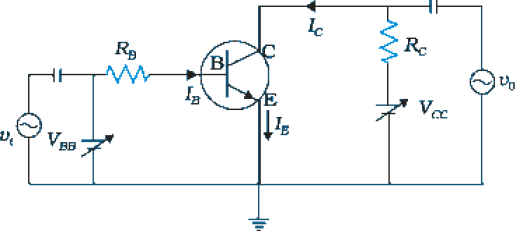
For a Silicon CE transistor amplifier, the audio signal voltage across the collector resistance of 2.0 k is 2.0 V. Suppose the current amplification factor of the transistor is 100 if the dc base current has to be 10 times the signal current. The dc current across through the collector resistance will be:
1. 0.1 mA
2. 10 mA
3. 1.0 mA
4. 0.01 mA
An n-p-n transistor conducts when:
| 1. | both collector and emitter are positive with respect to the base |
| 2. | collector is positive and the emitter is negative with respect to the base |
| 3. | collector is positive and the emitter is at the same potential as the base |
| 4. | both collector and emitter are negative with respect to the base |


1. \(6\) mA and leaving the base.
2. \(3\) mA and leaving the base.
3. \(6\) mA and entering the base.
4. \(3\) mA and entering the base.

© 2026 GoodEd Technologies Pvt. Ltd.