 Work , Energy & Power Part 2 (Conservation of Mechanical Energy, Relation between P.E. and Force, Power, Collisions)Contact Number: 8527521718Work , Energy & Power Part 2 (Conservation of Mechanical Energy, Relation between P.E. and Force, Power, Collisions)Contact Number: 8527521718
A motor pulls a block by giving a force of \(50\text{ N}\) at a speed of \(36\text{ km/h}.\) The power supplied by the motor to the block is:
1. \(500\text{ watt}\)
2. \(1800\text{ watt}\)
3. \(250\text{ watt}\)
4. \(200\text{ watt}\)
A ball falls from height H and loses 36% of its energy during impact with the ground. The height up to which the ball rises is:
1. 0.64H
2. 0.8H
3. 8.36H
4. 0.5H
A 40 kg boy is swinging on a swing. The power delivered by gravity force, when the swing is making an angle of 30° with the horizontal and the boy moving with a velocity of 8 m/s upwards, is: (g = 10 )
(1) - 1000 W
(2) - 500 W
(3) - 1600 W
(4) - 1600 W
When the work done by a conservative force is positive,
(1) the potential energy remains the same as initial.
(2) the potential energy decreases.
(3) the kinetic energy may increase.
(4) Both (2) & (3)
A particle is suspended by a light rod of length l. The minimum speed at which the particle should be projected, so that it moves in a vertical circle, is:
| 1. | \(3 \sqrt{g l} \) | 2. | \(\sqrt{2 g l} \) |
| 3. | \(2 \sqrt{g l} \) | 4. | \(\sqrt{5 g l}\) |
A moving particle of mass m makes a head-on elastic collision with a stationary particle of mass 2m. The fraction of kinetic energy lost by the first particle is:
1.
2.
3.
4.
A car of mass 100 kg and traveling at 20 m/s collides with a truck weighing 1 tonne traveling at 9 km/h in the same direction. The car bounces back at a speed of 5 m/s. The speed of the truck after the impact will be:
1. 11.5 m/s
2. 5 m/s
3. 18 m/s
4. 12 m/s
A constant force acts on a particle. At a certain instant when velocity of the particle is . The power of the force is zero, then
(1) 2a + 3b = 1
(2) a + b = 1
(3) 2a = 36
(4) a + b + 1 = 0
A chain of mass m and length l is kept on a smooth horizontal table with one-fourth of the chain overhanging from the table edge. Minimum work done in bringing the hanging part onto the table is:
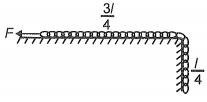
1.
2.
3.
4.
The principle of conservation of energy implies that:
1. the total mechanical energy is conserved.
2. the total kinetic energy is conserved.
3. the total potential energy is conserved.
4. the sum of all types of energies is conserved.
The figure shows the potential energy function U(x) for a system in which a particle is in a one-dimensional motion. What is the direction of the force when the particle is in region AB? (symbols have their usual meanings)
1. The positive direction of x
2. The negative direction of X
3. Force is zero, so direction not defined
4. The negative direction of y
A body of mass \(m\) moving at a certain speed suffers a perfectly inelastic collision with a body of mass \(M\) at rest. The ratio of the final kinetic energy of the system to the initial kinetic energy will be:
1. \(\dfrac{m}{m+M}\)
2. \(\dfrac{M}{m+M}\)
3. \(\dfrac{m+M}{m}\)
4. \(\dfrac{m+M}{M}\)
The mechanical energy of the system is conserved when work done by
1. conservative force is zero.
2. non-conservative force is zero.
3. non-conservative force is non-zero.
4. conservative force is equal to work done by the non-conservative force.
A particle is moving such that the potential energy U varies with position in metre as U (x) = ( - 2x + 50) J. The particle will be in equilibrium at:
1. x = 25 cm
2. x = 2.5 cm
3. x = 25 m
4. x = 2.5 m
Select the incorrect statement about potential energy:
| 1. | A change in potential energy is equal to work done against the internal conservative force.
|
| 2. | A change in potential energy is independent of the reference point.
|
| 3. | A change in potential energy depends on the reference frame.
|
| 4. | The potential energy at a point is not unique. |
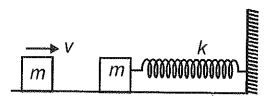
1. \(v\sqrt{\dfrac{m}{k}}\)
2. \(v\sqrt{\dfrac{2m}{k}}\)
3. \(m\sqrt{\dfrac{v}{2k}}\)
4. \(v\sqrt{\dfrac{m}{2k}}\)
The figure shows the potential energy function U of a system in which a particle is in one-dimensional motion. In which region is the magnitude of the force on the particle greatest? (x: position)
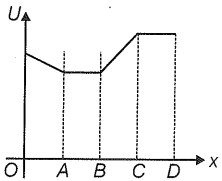
| 1. | OA | 2. | CD |
| 3. | AB | 4. | BC |
The potential energy of a particle varies with distance \(r\) as shown in the graph. The force acting on the particle is equal to zero at:
1. \(P\)
2. \(S\)
3. both \(Q\) and \(R\)
4. both \(P\) and \(S\)
A toy car slips down the smooth inclined plane as shown in the figure. It goes around the vertical smooth circle at the bottom, the relation between H and h is:
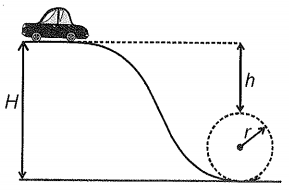
(1) H = 2h
(2) H = 3h
(3) H = 4h
(4) H = 5h
The ratio of velocities of a body connected to a string at points A, B and C to just complete vertical circular motion is:
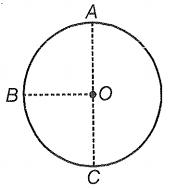
(1) 1: 2: 3
(2)
(3) 1: 3: 5
(4)
