 Current Electricity (EMF and Terminal Voltage, Wheatstone Bridge, Meter bridge and Potentiometer, Power)Contact Number: 8527521718Current Electricity (EMF and Terminal Voltage, Wheatstone Bridge, Meter bridge and Potentiometer, Power)Contact Number: 8527521718
Three resistances \(\mathrm P\), \(\mathrm Q\), and \(\mathrm R\), each of \(2~\Omega\) and an unknown resistance \(\mathrm{S}\) form the four arms of a Wheatstone bridge circuit. When the resistance of \(6~\Omega\) is connected in parallel to \(\mathrm{S}\), the bridge gets balanced. What is the value of \(\mathrm{S}\)?
| 1. | \(2~\Omega\) | 2. | \(3~\Omega\) |
| 3. | \(6~\Omega\) | 4. | \(1~\Omega\) |
A battery of internal resistance r, when connected across 2Ω resistor supplies a current of 4A. When the same battery is connected across a 5Ω resistor, it supplies a current of 2A. The value of internal resistance r is:
1. 2Ω
2. 1Ω
3. 0.5Ω
4. zero Ω
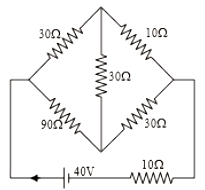
In the circuit shown in the figure, the current supplied by the battery is:
1. 2 A
2. 1 A
3. 0.5 A
4. 0.4 A
The potential difference between points A and B is:
1. 2 V
2. 6 V
3. 4 V
4. 3 V
In the circuit shown in the figure below, if the potential difference between \(B\) and \(D\) is zero, then value of the unknown resistance \(X\) is:
| 1. | \(4~\Omega\) | 2. | \(2~\Omega\) |
| 3. | \(3~\Omega\) | 4. | EMF of a cell is required to find the value of \(X\) |
| 1. | \(10^{\circ}\text{C}\) | 2. | \(5^{\circ}\text{C}\) |
| 3. | \(20^{\circ}\text{C}\) | 4. | \(15^{\circ}\text{C}\) |
A 220 V, 1000 W bulb is connected across a 110 V mains supply. The power consumed is:
1. 1000 W
2. 750 W
3. 500 W
4. 250 W

| 1. | \(7R\) | 2. | \(5R\) |
| 3. | \(4R\) | 4. | \(3R\) |
The wire AB shown in the figure has a uniform cross-section area and is 100 cm long. Where should the terminal D of the galvanometer be connected to the wire to get zero deflection in the galvanometer?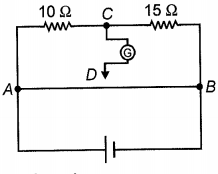
1. 40 cm from A
2. 50 cm from A
3. 40 cm from B
4. 80 cm from B
Two cells of emf \(E\) and internal resistance \(r_1\) and \(r_2\) are connected in series through an external resistance \(R\). The value of \(R\) for which the potential difference across one of the cells becomes zero will be:
| 1. | \(\dfrac{r_{1} r_{2}}{r_{1} + r_{2}}\) | 2. | \(r_{1} + r_{2}\) |
| 3. | \(|r_{1} - r_{2}|\) | 4. | \(\dfrac{r_{1}}{r_{2}}\) |
Two heater wires of equal length are first connected in series and then in parallel. The ratio of heat production in the two cases is:
1. 1 : 3
2. 1 : 2
3. 1 : 8
4. 1 : 4
Two batteries, one of emf \(18~\text{V}\) and internal resistance \(2~\Omega\) and the other of emf \(12~\text V\) and internal resistance \(1~\Omega,\) are connected as shown. Reading of the voltmeter is:
(if a voltmeter is ideal)

1. \(14~\text V\)
2. \(15~\text V\)
3. \(18~\text V\)
4. \(30~\text V\)
A current of \(2\) A is to be sent through a resistor of \(5 ~\Omega.\) Number of cells required in series, if each has emf \(2\) V and internal resistance \(0.5~\Omega,\) are:
1. \(40\)
2. \(30\)
3. \(20\)
4. \(10\)
The potentiometer wire PQ is 100 cm long and its resistance is 2r, where r is the internal resistance of the battery. The balancing length PC is equal to:
1. 25 cm
2. 75 cm
3. 50 cm
4. 40 cm
In a potentiometer arrangement, a cell of emf \(1.25\) V gives a balance point at \(35.0\) cm length of the wire. If the cell is replaced by another cell and the balance point shifts to \(63.0\) cm, then the emf of the second cell is:
1. \(1.27\) V
2. \(2.25\) V
3. \(3.27\) V
4. \(3.25\) V
The storage battery of a car has an EMF of \(12~\text V.\) If the internal resistance of the battery is \(0.4~\Omega,\) what is the maximum current that can be drawn from the battery?
1. \(30~\text A\)
2. \(20~\text A\)
3. \(10~\text A\)
4. \(40~\text A\)
A battery of emf \(10 ~\text V\) and internal resistance \(3~\Omega\)
1. \(10~\text V\)
2. \(8.5~\text V\)
3. \(1.5~\text V\)
4. \(7.2~\text V\)
According to this diagram, the potential difference across the terminals is:
(internal resistance of cell=r)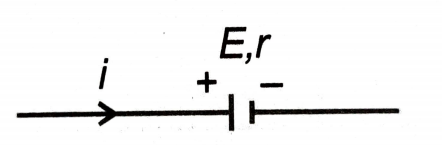
1.
2.
3.
4. Zero
Two cells of e.m.f. E1 and E2 are joined in series and the balancing length of the potentiometer wire is 625 cm. If the terminals of E1 are reversed, the balancing length obtained is 125 cm. Given E2>E1, the ratio E1:E2 will be:
1. 2 : 3
2. 5 : 1
3. 3 : 2
4. 1 : 5
The power dissipated in the circuit shown in the figure is \(30~\text{Watts}\). The value of \(R\) is:
1. \(15~\Omega\)
2. \(10~\Omega\)
3. \(30~\Omega\)
4. \(20~\Omega\)


